


The beginning of a new session is something most students take very lightly. They think, “Oh, it’s just the start, exams are far away, I have plenty of time.” And then suddenly it’s October, then November, then December — and they are sitting with half a syllabus left, panicking, crying, and regretting every single day they wasted. I have seen this happen. I have been through parts of this myself. So if you are reading this right now, at the very beginning of your session, consider yourself lucky — because you still have time to do this the right way.
Whether you are in Class 9, 10, 11, or 12 — whether you are under CBSE, ICSE, or SEBA — this article is for you. These are not tips I read somewhere online. These are things I genuinely believe in, things I learned from my own journey, my own mistakes, and my own results. I scored 84% in my Class 10 and 91% in my Class 12. That improvement did not happen by chance. It happened because somewhere between those two years, I understood what actually works — and more importantly, what does not.
So let me walk you through it, one point at a time.
1. Know Your Syllabus — Properly, Not Roughly
Let me be very direct about this. One of the biggest and most common mistakes that students make — and they do not even realise they are making it — is that they do not actually know their current syllabus. They just assume it is the same as last year. They borrow notes from seniors, they follow old question papers, and they study topics that were already removed from the syllabus months ago.
Every single year, boards like CBSE, ICSE, and SEBA make changes. Topics get added. Topics get removed. The pattern of the exam changes. And if you are studying based on what your senior told you or what some random PDF on the internet says, you are walking into your exam blindfolded.
So the very first thing you need to do — before buying new notebooks, before making a timetable, before anything else — is go to the official website of your board. Download your current year’s syllabus. Read it carefully. Mark the chapters that are included. Understand the exam pattern and the marking scheme. This one step alone can save you weeks of wasted effort and give you a clear direction from day one.
It sounds basic. It sounds obvious. But most students simply do not do it. Do not be most students.
2. Start With One Hour — But Make It Count Every Single Day
Now here is something I want you to think about honestly. Have you ever had a day where you felt super motivated, you sat down to study for five, six, even seven hours — and then the next day you studied for maybe 30 minutes — and the day after that, you did not open a single book? If yes, then you already know that this approach does not work. It feels productive in the moment, but it is one of the most damaging habits a student can have.
Consistency is worth ten times more than intensity. One hour every single day is worth so much more than seven hours one day and zero the next. Your brain does not learn by being flooded with information once in a while. Your brain learns by seeing the same things repeatedly, over time, in a steady and calm manner. That is just how memory and understanding work.
So what I want you to do is start small. Start with just one hour a day. Or even 30 minutes if that feels more manageable right now. The number is not the point — the consistency is the point. You study today. You study tomorrow. You study the day after. Even if there is a wedding in the house, even if relatives have come over, even if you are tired and not feeling it — you sit down for at least 10 minutes. You open your book, you read something, you write something. Just do not break that habit. Because once you break it, it becomes very easy to break it again and again.
Start small. Stay consistent. Build from there.
3. Practicals Are Not Optional — Give Them Fixed Time Every Day
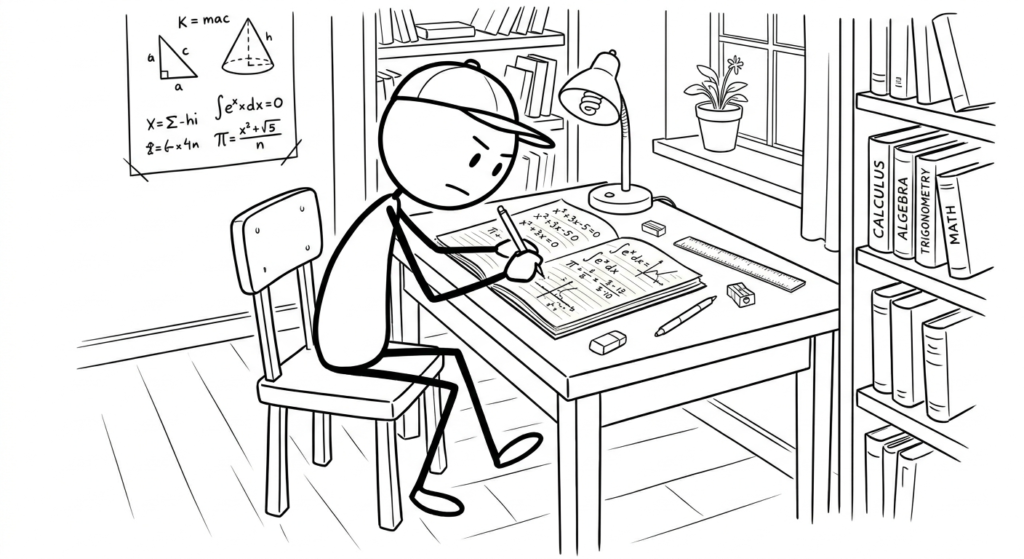
Okay, this is the point I feel most strongly about. And I say this because this is where I personally made my biggest mistake. I used to treat Maths and Accountancy like I would treat a theory subject — I would read it, understand the concept, and think I was done. I was not done. Not even close.
Subjects like Maths, Accountancy, Physics, and Statistics are not subjects you can understand just by reading. You have to practice them. You have to sit with a pen and paper and actually solve problems — wrong answers, corrections, re-attempts, and all of that. There is no shortcut. And the worst part is, if you avoid these subjects in the beginning, they keep building up. The concepts pile on top of each other. And by the time exams are close, these subjects feel completely impossible. They become the reason students cry the night before exams. They become the reason students walk out of the exam hall with regret.
So here is what I want you to do. Out of whatever study time you have — whether it is one hour or two hours — fix at least 30 minutes specifically for practical subjects. Not sometimes. Every day. And this 30 minutes should not be touched for anything else. Not for reading chapters, not for making notes — just for solving problems. Rotate the subjects if needed. Today you do Maths problems. Tomorrow you do Accountancy. Day after, Physics. But that 30 minutes stays fixed, every single day, no matter what.
If you do this consistently from the very beginning of the session, these subjects will not feel scary by the time exams arrive. They will actually feel familiar. And familiar is a very good feeling to have during exams.
4. Self-Study Is Its Own Thing — Do Not Mix It Up
I want to clear up something that a lot of students misunderstand. When I talk about studying one hour every day, I am not counting the time you spent in school. I am not counting your tuition hours or your coaching class hours. Those are completely separate.
Sitting in a classroom while a teacher explains something is not the same as sitting alone in your room and trying to understand it yourself. In school or tuition, someone is guiding you, answering your questions, pushing you forward. But self-study is different. In self-study, there is no one. Just you, your book, your notebook, and your own brain. You have to push yourself. You have to figure things out. And that struggle — that discomfort of sitting alone and trying — is exactly what builds real understanding.
A lot of students feel like they are studying a lot because they go to school and then tuition and then maybe one more class. But when they sit alone at home with a book, they realise they cannot do much on their own. That gap is the problem. Self-study fills that gap.
So whatever time I am suggesting — whether it is one hour or 30 minutes — that is your personal, self-study time. You are at home. You are at your desk or your study table. There is no teacher. And you are genuinely trying to learn on your own. That is the time that will truly reflect in your marks.
5. Make a Plan — But Make It Real, Not Just Pretty
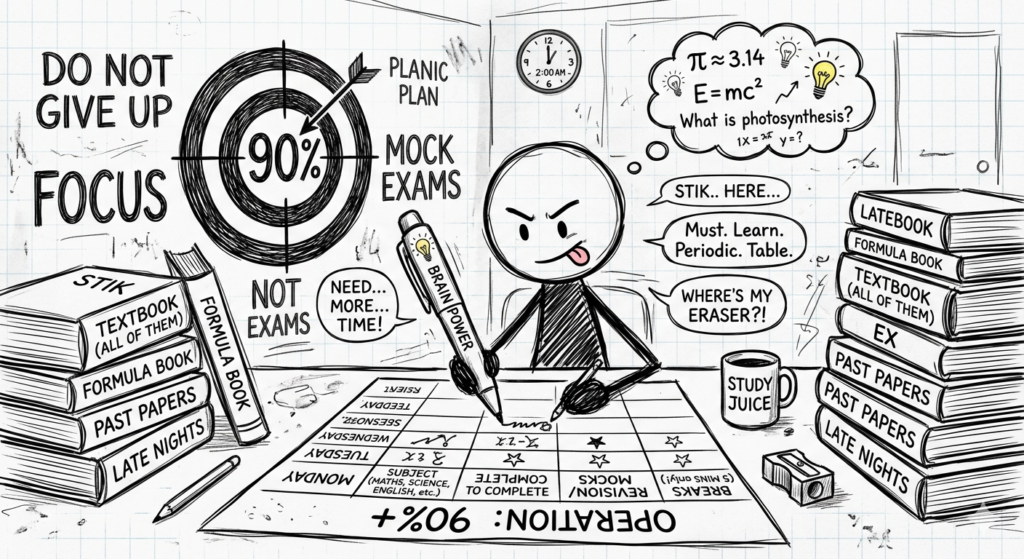
Every student loves making a timetable at the beginning of the session. Colourful pens, neat handwriting, perfectly divided time slots for every subject. And then within two or three days, the timetable is completely forgotten and the colourful chart is just sitting on the wall looking nice.
This happens because most students make plans that look good but are not actually realistic. They plan to study seven subjects in one day. They plan to finish three chapters every evening. They plan to wake up at 5 AM when they have never done that in their life. And when they inevitably cannot follow it, they feel like a failure and give up entirely.
So I want you to make a plan that is honest. A plan that reflects your actual life, your actual energy levels, and your actual pace. If you know you cannot study in the evening because of family time or other activities, plan your study time for after dinner or in the morning. If you know certain subjects take you longer, give them more days. Build in off days or lighter days so that when something unexpected happens, your plan does not completely fall apart.
Most teachers advise that students should complete their syllabus by end of November or early December — and that is a good target to aim for. But if you are starting in September and only studying one hour a day, finishing everything by November is not realistic unless you are being very smart and strategic about what you are covering and when. Be honest with yourself about that.
A realistic plan that you actually follow every day will always beat a perfect plan that you abandon in a week. Always.
If you take these five points seriously — knowing your syllabus, studying consistently every day, giving fixed time to practical subjects, doing genuine self-study, and making a realistic plan — I can say with full confidence that 85% and above is not just possible for you, it is very much achievable.
I say this not just as general advice. I say this from personal experience. I scored 84% in my Class 10 and 91% in my Class 12. That 7% jump came from understanding these exact things — from learning from my own mistakes, from being more consistent, more honest with my planning, and more serious about self-study. I am still learning. I am still growing. And I am sharing everything I know here because I genuinely want you to do well.
Follow this page. Content will be shared in different languages and different tones so that more students, from more backgrounds, can connect with it and benefit from it. Achieve Your Wildest Dreams Faster With Our’s Powerful Life-Changing Books
Share this with a friend who needs to hear it. And most importantly — start today. Not tomorrow. Today.
Thank you for reading. All the very best for your session. You have got this.
